Your marathon went badly. Look here first.
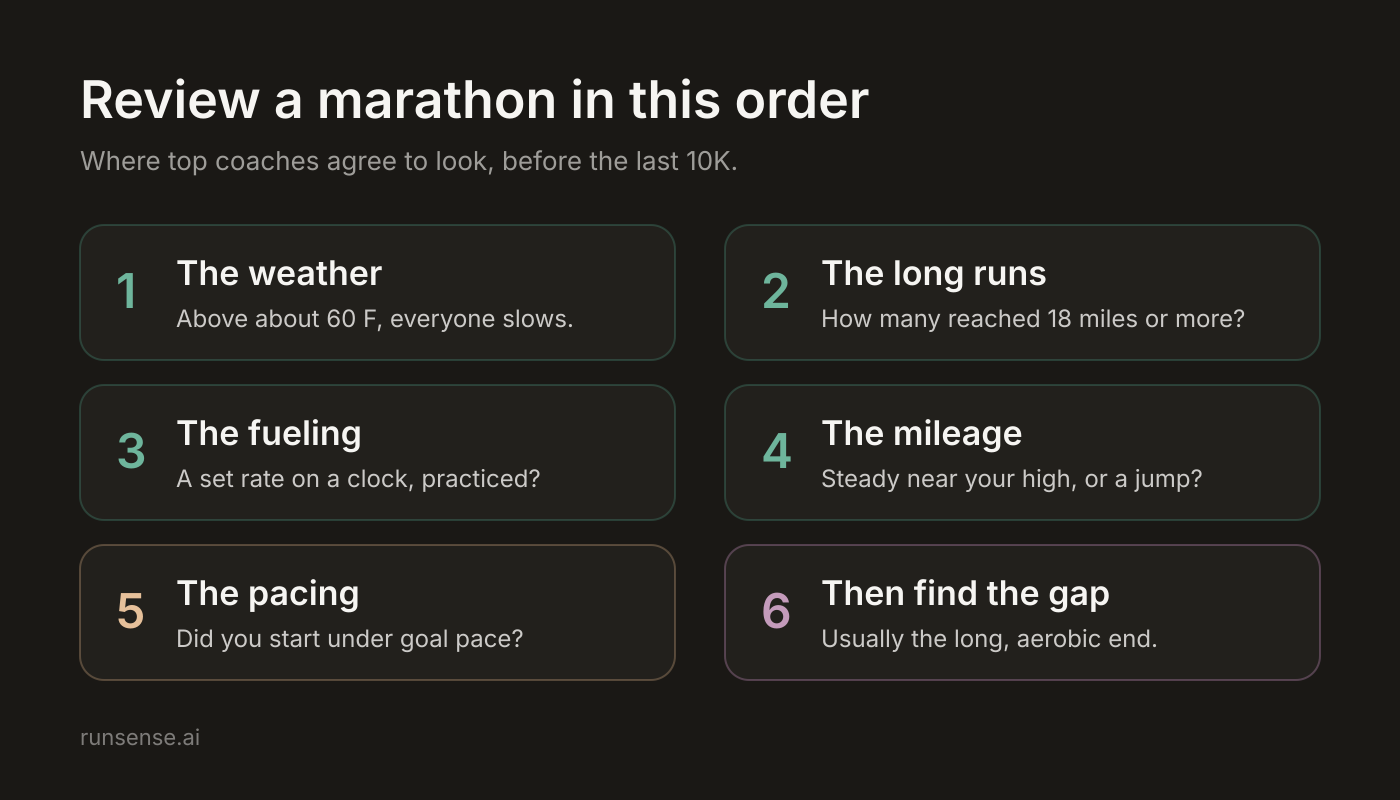
If your fall marathon went worse than you hoped, where do you look for answers? Many athletes look at the last 10k, because that's where it hurt the most. But coaches know to look somewhere else first.
The weather
Jason Fitzgerald of Strength Running checks it first (6 Marathon Problems That Slow You Down). Above about 60 F, in humidity or in the cold, everyone slows, and a warm race day after weeks of cold training hurts most. Steve Magness, who coaches distance runners, says humid heat costs more than dry heat, and treats 7:30 a mile in the heat as about 7:00. He and David Roche both have their runners go by effort on hot, humid days rather than chase a pace. If the field around you ran slow too, your time says less about your fitness than it feels like it does.
The long runs
Fitzgerald finds most slow marathons here. He wants the long run at about 10 to 12 miles 16 weeks out, so it can climb safely to about 20, and names only one or two runs of 18 miles or more as a chief reason a marathon goes slowly. Galen Rupp, who ran 2:06 and now coaches Kyle Merber, puts the long runs first too, ahead of the workouts and the weekly total. Roche adds what happens late in them: near the end of a long run he gives short efforts, such as four to six hill repeats of 30 to 60 seconds or a mile at marathon effort, to train the legs to keep working when they are tired. Count your runs of 18 miles or more in the 16 weeks before the race, and ask whether any of them asked something of you in the last miles.
The fueling
If you hit the wall, look here before you blame your fitness. Fitzgerald tells marathoners to take at least 60 to 75 grams of carbohydrate an hour, and more if their stomach handles it. A runner who has never fueled much can start every long run at about 60 grams an hour, a dose every 20 minutes, and raise it from there as the runs go well. That takes gels or a drink mix, because food alone rarely gets there. Rupp had Merber take gels on easy runs too, regularly, not once a month. Roche, reading recent studies, says that once a runner eats plenty of carbohydrate, how well they burn fat no longer predicts who fades late, and he has stopped prescribing fasted runs. Jason Koop's rule is that nothing is new on race day, and that includes the rate, not only the gel. Did you take a set amount on a clock in your long runs, and was race day's rate one you had practiced?
The mileage
Fitzgerald likes a runner to set one or two new weekly mileage highs in a year and spend much of the year near 90 percent of that high. Roche, and the coaches of professional marathoners interviewed on the Citius Mag Podcast, raise peak mileage a little from one build to the next rather than all inside one build, and one of those pros calls trying to get there fast the top mistake he has seen. A build that climbed from a quiet stretch straight to a new high asked a lot of the legs in the weeks that counted.
The pacing
Then look at your splits. The coaches we follow who talk about marathon pacing all start under goal pace; they differ only on how much. Fitzgerald runs the first mile or two 5 to 10 seconds a mile slow and speeds up only from about mile 21 if he feels good. Chris McClung of Running Rogue starts experienced marathoners about 30 seconds a mile slow and newer ones 45 to 60 slow, and says to bank energy, not time. Brant Stachel, who coaches marathoners, calls a fast start a loan with exponential interest. He also gives his runners a dress rehearsal three to four weeks before the race: 90 to 100 minutes at marathon pace, in race shoes, with race fueling and the race breakfast (Strength Running). If you never ran one, mile 18 was the first time you tested your pace and your gels together.
What to do with the answer
Stachel and Fitzgerald both look for the gap: how your marathon compares with your shorter race times, and what you have not worked on in the last year or two. For more than nine in ten runners, Stachel says, the gap is at the long, aerobic end. So a spring plan that fixes a bad fall marathon usually has more long running, practiced fueling and steadier weeks in it, not harder workouts. Kim Conley wants her runners comfortable with two hours on their feet before the marathon-specific weeks begin (Ali on the Run Show), which makes December and early January the time to build it.
What a coach does with this
This review is what a coach does with you before writing the next plan, and it is what Runsense does. Runsense is a running coach for everyone. Like a human coach, it gets to know you: your goal, fitness, and schedule. It builds a plan you can actually complete, and keeps it up-to-date as your runs and feedback come in. You can ask your coach anything, any time: to move a session, why the plan looks the way it does, or how training works. Start your free 14-day trial.
Expert running advice, in your inbox.
Plain-English coaching from the Runsense team. No spam.