TrainingPeaks alternative
A coach that answers right away, for $8.99 a month
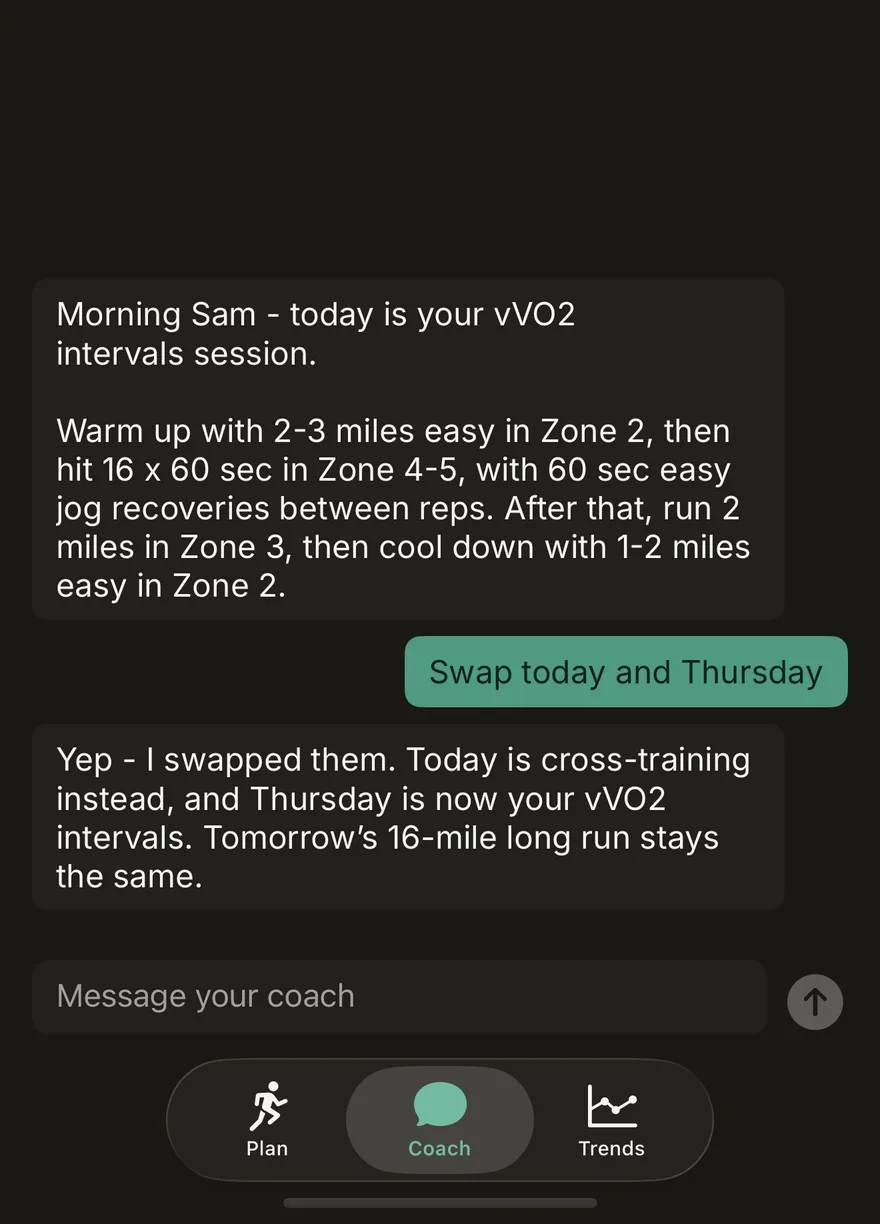
On TrainingPeaks you either coach yourself, or you pay from $149 a month for a coach whose time is rationed by the tier you bought. Runsense has no meter on it: ask anything, as often as you like, and your plan changes the day your life does.


14 days free · cancel anytime
Side by side
TrainingPeaks vs. Runsense
| TrainingPeaks | Runsense | |
|---|---|---|
| What it is | A platform for planning and analysis, plus a coach you hire separately | A coach who maintains and adapts your plan, and analyzes your workouts |
| Who decides what you do next | You, or the coach you pay from $149 a month | Your coach, every day, included |
| How fast you get an answer | Two emails a month at a cost of $149/month | Right away, as often as you ask |
| When life changes | One plan adjustment a month at $149, two at $229 | Tell it what changed; it rebuilds the week and says why |
| Feedback on a run | Charts you read yourself, or key workouts from $229 a month | Every run, in plain language |
| Where the plan comes from | You build it, you buy one, or a coach writes it | Built for your goal and your real week, included |
| What a year costs | About $235 self-coached with two plans, $1,788 and up with a coach | $69.99, everything included |
| Fitness, fatigue and form | Tracked, and yours to interpret | The same numbers, read for you |
| Learning curve | Steep | Easy as texting |
| Goals it coaches | Multisport: triathlon, cycling, running and more | Running goals, with your rides, swims and strength work incorporated |
| Who owns it | Part of Garmin since July 2026 | Independent |
TrainingPeaks features and pricing change; we keep this table accurate and dated. Last checked: August 2026.
Add it up
Premium is not the whole bill.
TrainingPeaks Premium is $134.99 a year, and it buys tools rather than training. The plan is a separate purchase from its store, where the best-selling marathon plans run about $39.95 to $49.95. Each one is a fixed template you buy once, so a new race, a new goal or a changed schedule means buying another.
A realistic self-coached year is around $235. Runsense is $69.99, with the plan included and rebuilt as often as your life needs it.
The coached tiers
What $149 a month actually buys.
These are TrainingPeaks' own published packages. Bronze costs more in a month than Runsense costs in a year, and it buys two emails and one change to your plan.
| Bronze $149/mo | Silver $229/mo | Gold $359/mo | Runsense $8.99/mo | |
|---|---|---|---|---|
| Messages | 2 emails per month | Unlimited emails | Unlimited emails | Unlimited, answered right away |
| Calls | 1 per quarter | 1 per month | Unlimited | A text thread, always open |
| Plan changes | 1 per month | 2 per month | Unlimited | Whenever your life changes |
| Feedback on your runs | Not included | Key runs | Every run | Every run |
TrainingPeaks coached pricing as published on trainingpeaks.com, checked August 2026.
The honest economics
Why coaching costs what it costs.
None of this is the coach's fault. TrainingPeaks bills you and keeps 15%, so your $149 leaves your coach $127. At that rate a coach needs roughly 42 athletes on their roster to earn a median living, and nobody carrying 42 athletes can read every run you do.
That is what the tiers are really describing: not how much your coach cares, but how much of their week your money can buy.
The floor is also a rule rather than a market price. Coaches in the matching service agree not to price their packages below those tiers, and a coach who wants to work with you outside it pays a $300 buyout.
What that looks like
The questions a chart cannot answer.
These are the things self-coached athletes actually get stuck on. Every one of them is a reply, not a dashboard.
You are not sure this week should have intensity in it.
The charts show the last four weeks. They do not have an opinion about the next seven days.
Should I still do the intervals this week? Legs have felt flat since Saturday.
Flat since Saturday tracks: that long run was your biggest in five weeks and you ran the last 3 miles faster than the rest. Let's keep Thursday but cut it to 5 x 3 minutes instead of 8. Same intensity, about half the volume. If the legs come back by Wednesday, tell me and I'll put the other three back.
A decision, with the reason, and a way back if you feel better.
You cannot tell if this tiredness is normal.
This is the question the numbers are worst at, because the honest answer depends on what kind of tired you mean.
Is this fatigue normal or should I be worried?
Week nine of a build is supposed to feel like this, and your paces have not slipped, which is the reassuring part. One thing I want to separate though: is it tired legs, or tired all over, the kind where the stairs feel like a lot? The first is training. The second is the one we act on.
It asks the one question that tells the two apart, instead of guessing.
You missed a session and the week is now a puzzle.
On a bought plan this is your problem to solve. Dragging the workout somewhere is not the same as knowing whether it belongs there.
Missed Tuesday, work blew up. Does the week still work?
It does, and I have already moved it. Tuesday's tempo is on Wednesday now, and Thursday drops to an easy 40 so you are not stacking two hard days. Saturday's long run stays exactly where it was. That is the session this week is actually built around.
Rebuilt for you, with the one session that mattered protected.
You want to know why a session is in there at all.
A plan you bought cannot tell you. A coach with 42 athletes may not get to it this week.
Why 6 x 800 and not just a tempo run?
Because you are strong at holding a steady effort and less comfortable when the pace gets uncomfortable and you have to sit in it. 800s let you visit that discomfort six times with a rest between, instead of once for 25 minutes. Six weeks from now, when you are chasing that finish, it is the thing that will hold.
Ask about any session, any day. Every one of them has a reason.
Your week has a shape that no template knows about.
This is the one an off-the-shelf plan can never fix, because it was written before it met you.
My Tuesdays and Thursdays are gone all semester. Evening classes.
Good to know, and that is a real constraint rather than a one-off, so I will build around it from here. Quality moves to Wednesday and Saturday, easy runs fill Monday and Friday, and the long run stays Sunday. You will not see me put a session on a Tuesday again.
It goes on your file, and every week after this one is built around it.
Built, not assembled by you
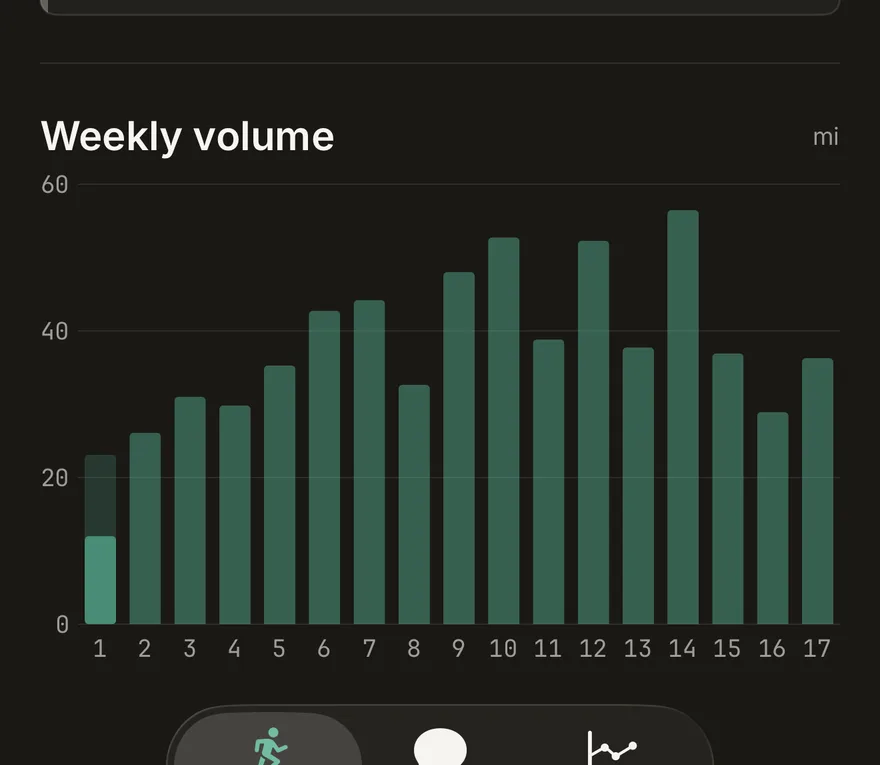
Hard weeks, easy weeks, taper. On purpose.
Runsense builds the whole arc to your race: blocks that climb, cutback weeks that let the work land, and a taper that arrives at the right time. You do not periodise it, price it, or reassemble it when something moves.
And you keep the numbers. Runsense tracks fitness, fatigue and form on the same convention you are used to, from the same heart-rate data. The difference is that your coach reads them and tells you what they mean for this week.
The honest bit
When TrainingPeaks is the better fit.
Your goal is not a running one. Runsense coaches you toward a running race. It reads your rides, swims and strength sessions and builds your running week around them, but it will not write you a triathlon plan or periodise a cycling season. If the goal itself is multisport, TrainingPeaks is the right tool and we would rather say so here.
You have a human coach you like. Keep them. A coach who knows you is the best thing in this sport, and the economics above are the reason they are worth what they charge.
You want deep analysis and you enjoy it. Power curves, WKO-grade modelling, years of data to pore over: that is what TrainingPeaks is genuinely great at, and some athletes love that work. Runsense is for the ones who would rather be told what it means.
A coach for the price of an app.
Everything included: the plan, the answers, and the rebuilds.
New members get their first 14 days of coaching free. TrainingPeaks Premium also offers a 14-day trial, so you can run both and see which one actually answers you.
Getting started
What you need to start.
An iPhone and somewhere your runs already land. Strava, Suunto and Polar connect from Settings in one tap; Garmin and COROS runs come in through Apple Health, which stays connected as a backup for everyone.
Your coach reads that history when it builds your first plan, so you are not starting from an empty calendar.
Questions
TrainingPeaks alternative: common questions.
Is Runsense cheaper than TrainingPeaks?
Yes, and the gap is wider than the subscription line suggests. Premium is $134.99 a year and does not include a plan; plans are bought separately, with the best-selling marathon plans around $39.95 to $49.95 each. Coached tiers start at $149 a month. Runsense is $8.99 a month or $69.99 a year, plan included and rebuilt whenever you need it.
Can I bring my TrainingPeaks history across?
Not from TrainingPeaks directly. Your run history comes in from wherever your runs are recorded: connect Strava, Suunto or Polar in one tap, or Apple Health, which also carries Garmin and COROS runs. Your coach reads that history when it builds your plan.
Do I lose my fitness and fatigue numbers?
No. Runsense computes fitness, fatigue and form on the same convention TrainingPeaks uses, from the same heart-rate data, so the numbers are the ones you are used to. The difference is that your coach reads them and tells you what they mean for this week, instead of leaving the interpretation to you.
Do I need a Garmin?
No. Runsense works with whatever you already run with. Strava, Suunto and Polar connect directly from Settings; Garmin and COROS runs arrive through Apple Health, which stays connected as a backup for everyone.
How is this different from hiring a human coach?
A great human coach is worth their price and Runsense will not pretend to be a person. What it does is the part you are actually paying a coach for day to day: it builds a real plan toward your goal, reads every run you do, answers whenever you ask, and rebuilds the week when your life changes. It does that without a monthly limit on messages or plan changes.
Stop interpreting. Start being coached.
14 days free. Bring the runs you have already done.
Pricing and features compared as of August 2026, checked against trainingpeaks.com. TrainingPeaks: Premium $19.95/month or $134.99/year with a 14-day trial; coached packages $149, $229 and $359 per month; training plans sold separately, best-selling marathon plans about $39.95 to $49.95. Runsense: $8.99/month or $69.99/year, 14 days free. Figures and features change, so check each provider for current terms. TrainingPeaks is a trademark of its owner and is not affiliated with Runsense.