Runna alternative
A Runna alternative that actually coaches you
Runna gives you a training plan. Runsense gives you a coach: one that builds around the week you actually have, explains why every session exists, reads every run you do and tells you what it meant, answers whatever you ask, and adapts as your training and your life change.


14 days free · no credit card · cancel anytime
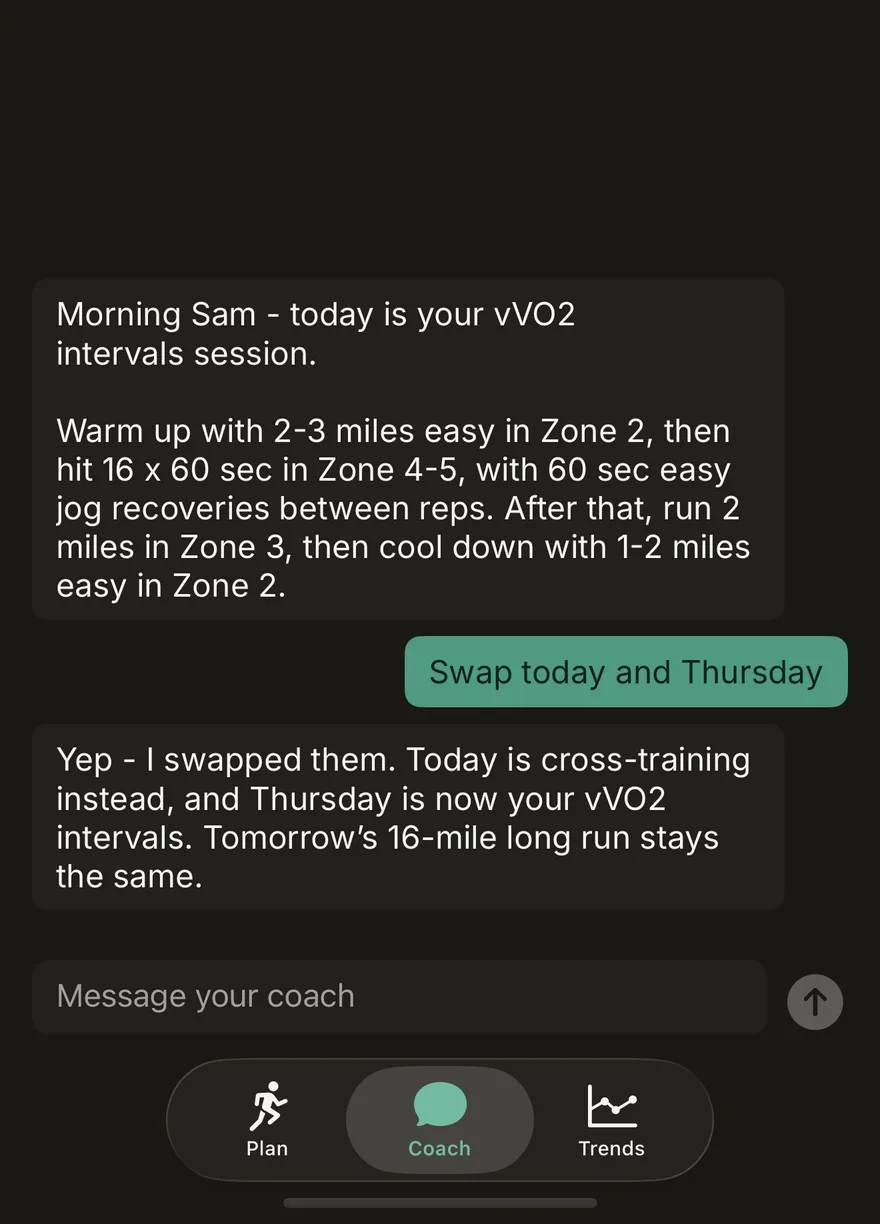
Side by side
Runna vs. Runsense
| Runna | Runsense | |
|---|---|---|
| Form | Plan + dashboard in an app you open daily | A coach who owns getting you to the start line |
| Adapts to | Your recent paces and times | Your runs and your life: pace, heart rate and effort, plus a sick week, travel, a race that moved |
| Interaction | You adjust the plan yourself, with their tools | Tell it what changed; it rebuilds the week and says why |
| Asking questions | A support team, for app and training questions | Text your coach like a person, any time |
| Your history | Each plan starts fresh; you re-enter your recent mileage | Carries across plans, and gets sharper the longer you train |
| Your weekly commitments | Runs outside the plan don't count toward it | Tell it once, and every week is built around it |
| Effort | Open app, sync, read plan | Run. Your coach does the rest. |
| Free trial | 7 days | 14 days free, no credit card |
| Price | ~$19.99/mo | $8.99/mo |
| Independence | Now part of Strava | Independent, not part of Strava or any platform |
Runna features and pricing change; we keep this table accurate and dated. Last checked: August 2026.
What that looks like
What having a coach actually means.
A Runna plan is more fixed than it looks: the sessions come from a small set of standard workouts, and the paces are scaled from the numbers you entered at setup. That is how a plan app works at scale, and it is why a formula can only ever answer with another formula. Below are five ordinary moments, in real exchanges, where a coach does something else.
You want to know why you're doing a session.
A plan can hand you 16 x 60 seconds. It cannot tell you what the session is for, which is the difference between following instructions and understanding your own training.
Why is Tuesday 16 x 60 seconds? Feels like a weird session
That Tuesday session is there to build power and running economy without a big aerobic cost. Short uphill reps let you run hard with good mechanics and lower impact than flat speed, and 16 x 60 seconds gives you enough total work to matter while each rep stays controlled rather than turning into a slog.
Ask about any session, any day. Every one of them has a reason.
Your Tuesdays and Thursdays are gone all semester.
Not an emergency, just your life. The plan should be built around it from the start rather than fought with every week.
Heads up, I've got class Tuesday and Thursday evenings all semester so I can't run those days. Saturdays are my only long day.
I've updated your standing schedule around that: no running Tuesdays or Thursdays, and Saturdays are your long-run day. I'll build the week around that from here.
It goes on your file, and every week after this one is built around it.
You cut the long run short in the heat.
You did 9.9 of the 16 miles. A plan records a miss. What you want to know is what the day actually did for you.
Nice work getting the 9.9 mi easy moderate long run done today. How did it feel? And how hard was the effort, 1 to 10?
6/10 because of the heat.
Got it. I recorded this as 6/10. For the run itself, 9.9 miles with average HR 153 is right in your Zone 2 range, so that lines up fine for an easy-moderate long run day. Tomorrow stays strength.
It asked, and it read your actual heart rate against your actual zones before ruling.
Your knee starts talking to you.
The gap runners named most often in our survey: there is no way to tell the app you need to cut back. This is the moment that decides a season.
my knee's been clicking and a bit achy between runs (ok during them) since day before yesterday. something I should worry about?
Clicking on its own is usually nothing, but a one-sided knee that's been aching between runs is worth reading carefully before a hard day, so I've made tomorrow an easy 30-minute run instead of the tempo.
Tomorrow changed before it became an injury, and it asked the question that tells it which kind this is.
You wake up with a sore throat.
The session is still sitting there, and you are guessing: push through, skip it, and then what happens to the rest of the week?
I think I'm coming down with something. Scratchy throat since last night. Should I still run today?
Yeah - skip the run today. I've taken today's 5 miles off the plan and marked today as no running while this declares itself. A scratchy throat that started last night is enough reason to give your body the day. If it stays just mild and above the neck, tomorrow can still be easy cross training only if you're clearly feeling better; if it turns into chest symptoms, fever, or body aches, don't train. Check in tomorrow and tell me what it turned into.
It decides, it changes the plan itself, and it tells you what would change its mind.
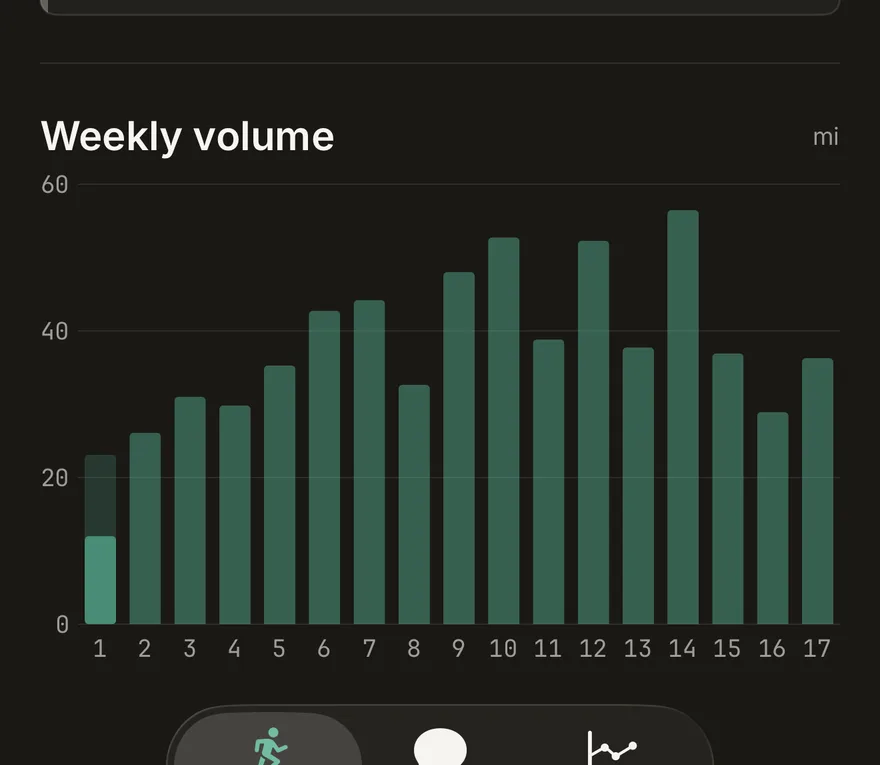
Built, not generated
Hard weeks, easy weeks, taper. On purpose.
Every week has a job. The build weeks stack, the cutback weeks let the work land, and the taper brings you to the line fresh. You can see the whole arc from day one, and when your life moves, the arc gets rebuilt around it rather than quietly falling out of date.
What runners told us
The plan was never the hard part.
We asked runners what actually frustrates them about plans, apps and coaching, and almost none of the answers were about the quality of the plan. It matched the wider research we started from: 165 running-community threads and more than 1,800 comments, where the top four frustrations were communication (64%), personalization (61%), relationship (55%) and adaptability (52%).
Building a good plan is the part this industry already solved. The part still missing is someone paying attention to you while you run it.
The honest bit
When Runna is the better fit.
Some runners genuinely enjoy the controls: browsing plans, moving sessions around, tuning the week themselves. Runna does that well, and if a daily app habit is what keeps you on track, it is the better fit. Runsense is for the runner who would rather hand that job to a coach and spend their attention on running.
Pricing & trial
A coach for the price of an app.
14 days free, no credit card. Cancel anytime.
A great human coach runs $150–$300/mo, usually split across 30–45 athletes. Runsense gives you a coach who actually knows and has time for you, at a fraction of the cost.
Getting started
What you need to start.
An iPhone, and a way for your runs to reach us: Strava, Suunto or Polar connect directly in one tap, and Apple Health covers everything else, including Garmin and COROS. Runsense is iPhone-only today. From there you just run: each session lands with your coach, who tells you what it means for the week ahead.
Questions
Runna alternative: common questions.
Is Runsense cheaper than Runna?
Yes, on both plans: $8.99 a month against Runna's ~$19.99, and $69.99 a year against $119.99. But price isn't really the point: the difference is a coach that adapts to your life, not a cheaper plan in an app.
Can I use it with Strava?
Yes. Strava, Suunto and Polar all connect directly from Settings, in one tap. Garmin and COROS runs come in through Apple Health today, which also stays connected as a backup for everyone.
Do I have to use an app every day?
No. The iOS app is there whenever you want it, to check your plan, your history or your settings. But you are not required to live in it to get the benefit: your coach reads your training as it comes in and tells you what changed, so nothing depends on you remembering to open anything.
How is this different from other AI running coaches?
Several AI coaching apps now exist, some cheaper than us, but most share the same shape: a plan generated once, by a system that never looks at how the plan actually went. Runsense's difference isn't "AI." It's attention: it reads your real training, listens to what you tell it, and changes what comes next. If price is your only filter, there are cheaper plan-generators. If you want something that behaves like a coach, that's us.
Is an AI coach as good as a human one?
A great human coach is wonderful, and usually $150–$300 a month, often split across 30 to 45 athletes. Runsense won't pretend to be a person, but it does what a great coach does: it learns your training and your history, builds a real plan toward your goal, and rebuilds it as your body and life change, easing off when you tell it you're wrecked, pushing when you're ready, adjusting early when something starts to hurt so it doesn't become an injury. It's in your corner every day, and it answers when you ask, all for a fraction of the cost.
Meet your coach.
Download Runsense and start training today.
Pricing and features compared as of August 2026, checked against runna.com. Runna: $19.99/month, $119.99/year, 7-day free trial (US pricing). Runsense: $8.99/month or $69.99/year, 14 days free. Figures and features change, so check each provider for current terms. Runna is a trademark of its respective owner; Runsense is independent and is not affiliated with or endorsed by Runna.