Check where your spring plan starts
If you are running a spring marathon, your plan starts soon. A build of 16 to 18 weeks to a race in April begins in December or early January, and most runners pick theirs now, from an app, a book or a club.
Every one of those plans was written for a runner. Whether it was written for you depends on where it starts. A plan that begins above the running you do now does not show it on day one. It shows it in weeks two to six, as tiredness that builds from week to week, or an ache that is still there on the next run.
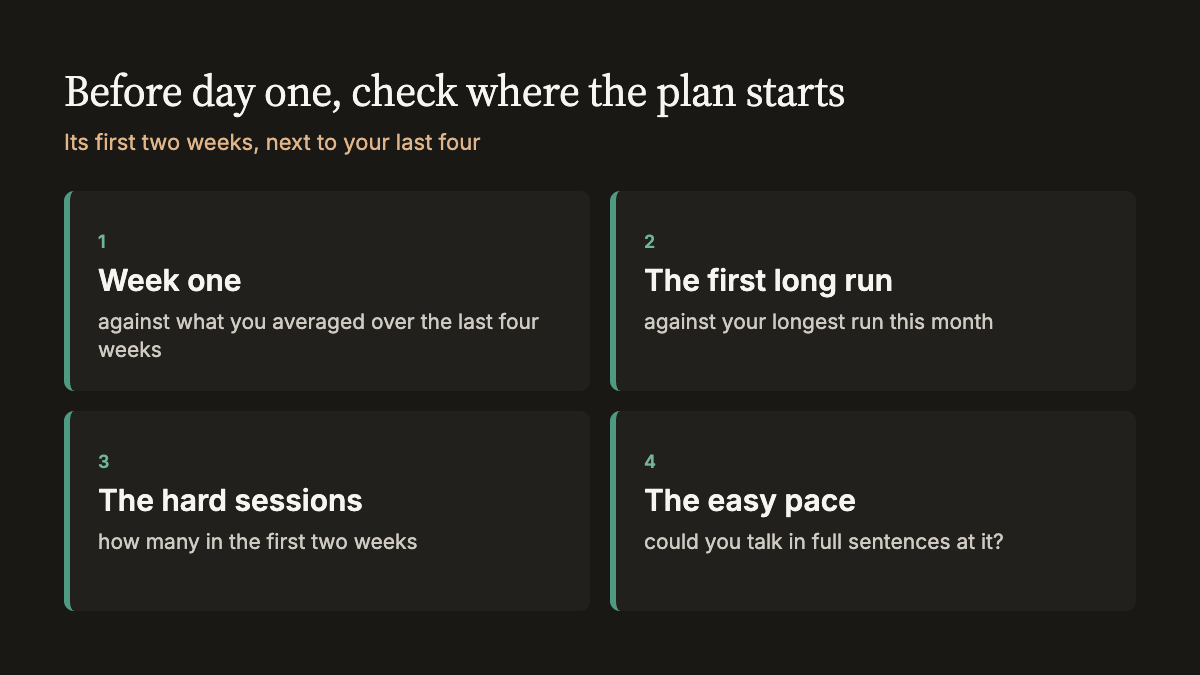
You can find out before you start. Lay the plan's first two weeks next to your last four.
Week one against your last four weeks. Add up what the plan asks for in its first week and compare it with what you have averaged lately. If week one is clearly more, the plan starts above you, and every week after it builds on that.
The first long run against your longest run this month. A first long run well past anything you have run in the last month is a jump, not a step.
The hard sessions. Count the runs with intervals, tempo or goal pace in the first two weeks. The less you were running before, the fewer of these your legs are ready for.
The easy pace. Easy running is conversational. If you could not talk in full sentences at the plan's easy pace, its paces were set from a goal faster than your fitness today.
A plan that fails one of these is not a bad plan. It starts on the wrong rung. A published plan is a ladder, and you join it at the rung that matches what you run now: start a few weeks into it, repeat its easier weeks, or set the goal time it asks for closer to the runner you are this month.
Once you start, check the day after. Chris McClung and James Dods of Running Rogue give a test on episode 405: you should finish a recovery run feeling better than when you started it. A long run that leaves you on the couch for the afternoon, or a workout that makes you dread the next easy run, was too hard. One of those is information. Two in a row is the plan telling you it is ahead of you.
A free grade of your plan. You can now send us the plan you follow, as screenshots, a PDF or pasted text, tell us your race and the running you do now, and a coach grades how well it fits you, from A to F, and says why. Grade your plan. We have also written up how to tell for the plans runners ask about most: Runna, Garmin Coach, Nike Run Club, Couch to 5K and Hal Higdon's Novice 1.
What your coach does with this. Runsense starts from the running you do now. It works back from your race date and sizes the whole block to your fitness today, your history and the days you run, so week one looks like the weeks you have just had. It reads every run, and when you tell it Saturday's long run flattened you, it reworks the plan and tells you what moved and why. If you haven't tried it, start your free 14-day trial.
Expert running advice, in your inbox.
Plain-English coaching from the Runsense team. No spam.