Is a running coach worth it? What the money buys
You have been following a plan from an app or a book. Some weeks it fits and some weeks it does not, and you are starting to wonder whether a coach would make the difference. Is a running coach worth it, and what would one do that your plan does not?
The plan is the smallest part of what a coach does. What you pay for is someone who keeps changing it as your life and your running change.
A coach writes your plan, not a plan
Anne Tisdell, a CTS coach, says on the KoopCast (episode 225) that she would never hand an athlete her own plan, even for the same race, because jobs, lives and backgrounds differ. She can review two athletes training for the same race back to back, one with 10 hours a week and one with something different, without needing to ask why the two plans look nothing alike.
That is the first thing a coach does. A plan from an app or a book is written for a runner who does not exist. A coach starts from the one who does: the hours you have, the runs you have done, the race you picked.
The real work is the feedback loop
Jason Koop, who coaches ultrarunners at CTS, has been asked to look at about 30 athletes who had run themselves into overtraining. On KoopCast 242 he says the common thread was not high mileage. It was a program not tailored to them: static, copied from someone else, and not responding to what the athlete said.
His guest, the sport scientist Sophie Herzog, has athletes keep notes on motivation, mood, sleep and irritability, and wants a comment even when everything is fine. Koop tracks heart rate variability with his athletes but treats the numbers as a fail-safe, not a replacement for honest, consistent communication.
So most of a coach's value comes after the plan is written. You tell them the long run felt awful, or that work is crushing you, or that a knee is talking. They change what comes next. A plan that never hears from you cannot do that, however well it was built.
Most weeks are not the plan's weeks
Tisdell says about 90 percent of her athletes go through busy or stressful stretches. In those, she scales down how perfect the training has to be and keeps the key sessions (KoopCast 225).
Chris McClung of Running Rogue goes further. Some seasons of life do not allow performance at all, however focused the runner (Running Rogue 422). Then the choice is to change the structure of the week or drop to maintenance, hold a baseline and adjust expectations. In his words, "There is no rush."
Knowing which of those you are in, and what to cut, is the judgment you are paying a coach for.
What the money buys
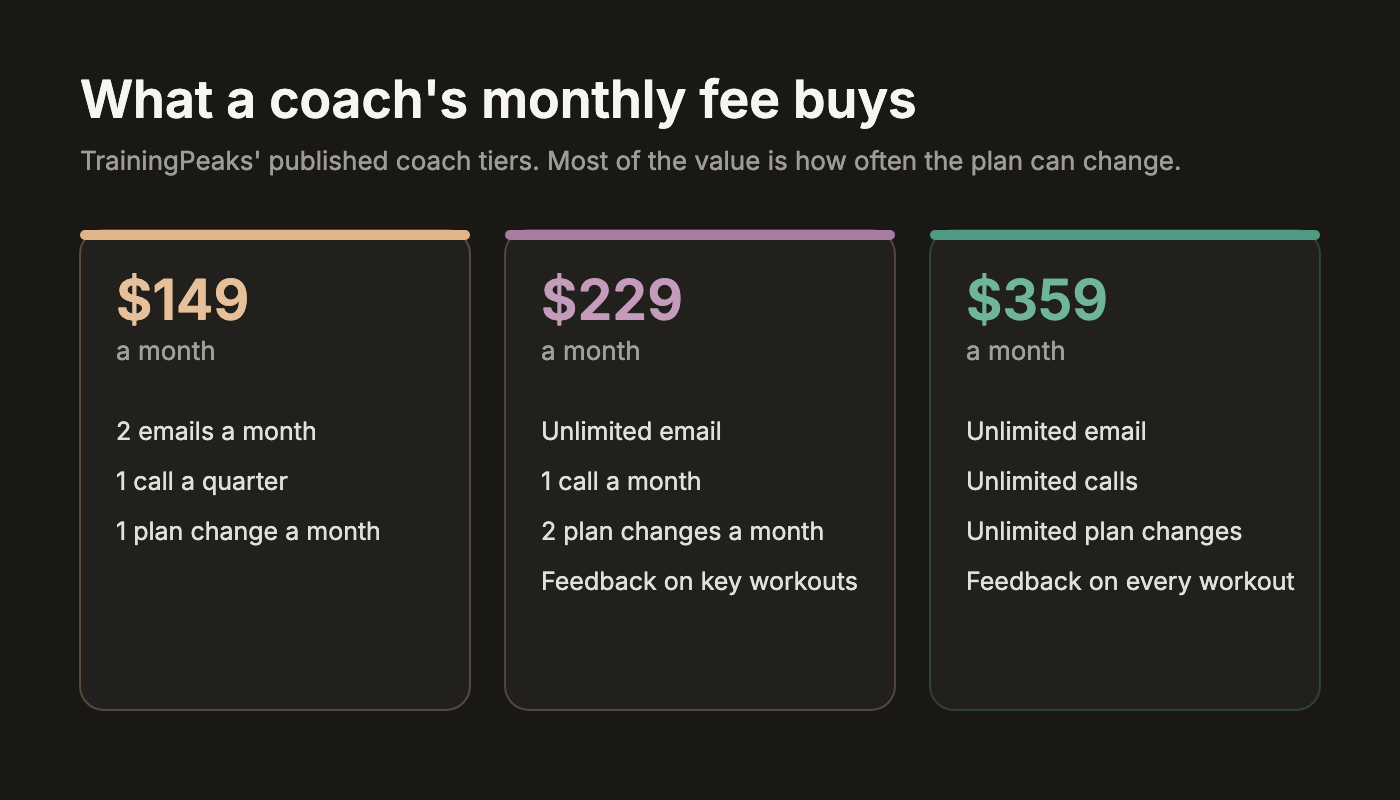
TrainingPeaks matches runners with coaches at three published tiers:
- $149 a month: two emails a month, one call a quarter and one plan adjustment a month.
- $229 a month: unlimited email, one call a month, two adjustments a month and feedback on key workouts.
- $359 a month: unlimited email, calls and adjustments, and feedback on every workout.
Read those against the feedback loop above. At the first tier, a cold, a work trip and a bad long run in the same month get one change to the plan between them. The coaching Koop and Tisdell describe, where the plan answers whatever you tell it, sits at the top tier, and an experienced coach can cost well past that: CTS lists its premier coaching at $1,295 a month or more.
Is a coach worth it for you?
Ask yourself four questions.
- When your week goes sideways, do you know what to change? If you would rather someone else decided, that decision is what a coach sells.
- Do you know why each session in your plan is there? If not, you cannot tell which one to keep when you can only fit one.
- Do you keep running a plan after it stops fitting? That is the static, copied program Koop kept finding in the overtrained athletes he looked at.
- Will you tell your coach the truth? A coach can only change what they hear about. If you would not send a note saying the run felt awful, the fee buys a plan you could have had for free.
If you answer yes to the first three and no to the fourth, a plan is probably enough. If you need someone to listen and change things often, look for coaching that answers whenever you write, not twice a month.
Our guide to overtraining covers the warning signs Koop and Herzog describe.
What Runsense does
Runsense works with you like a human coach would: it learns your goal, your fitness and the week you actually have, and designs a plan you can complete. When the week goes sideways, tell it, and the plan updates as your runs and feedback come in, as often as that happens. Ask it anything, any time, from moving a session to why the plan is built the way it is. It costs $8.99 a month. If you haven't tried it, start your free 14-day trial.
Expert running advice, in your inbox.
Plain-English coaching from the Runsense team. No spam.