How to keep your running fitness over the winter
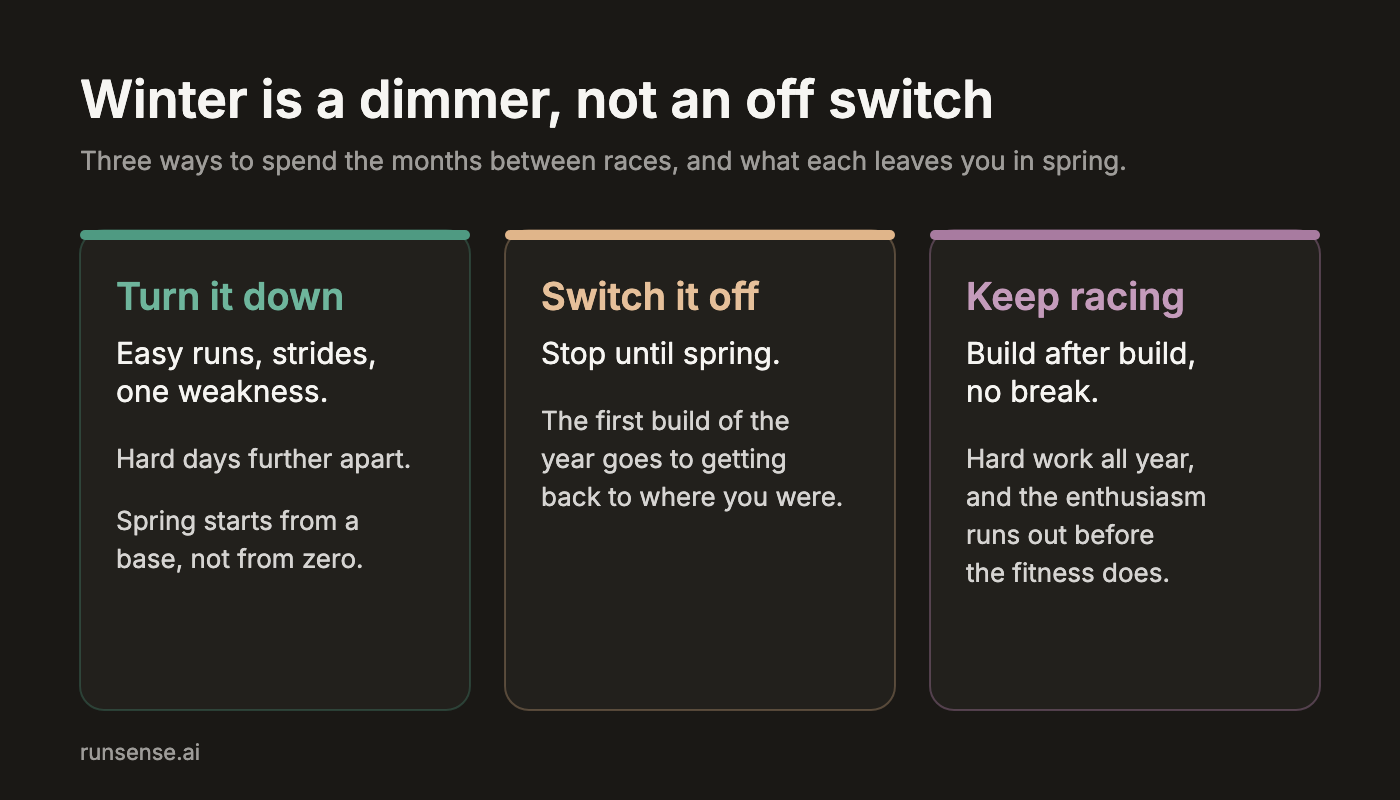
The fall race is behind you. The next one, if you have picked it, is in April or May. Between them sit four or five months of short days, cold mornings and a holiday calendar, and most runners do one of two things with them: they stop until spring, or they carry on as if the next race were in three weeks.
Neither is what a coach would have you do.
Turn it down, not off
Jason Koop, who coaches ultrarunners at CTS, calls winter a dimmer switch, not an off switch (KoopCast 209). He keeps a small core of training going: some work on a weakness, some cross-training, some strength. Then he turns the total down, by maybe 20 to 30 percent across volume, intensity and how often the hard days come. The two mistakes he sees are backing off completely, and backing off a little for too long.
A runner who stops in December spends February getting back to where they were in November. A runner who turns it down starts the spring build from a base.
Spend it on easy running and strides
Chris McClung, who coaches recreational marathoners at Running Rogue in Austin, tells runners who go from race to race to take a block, every so often, of three to six months of easy running plus strides (Running Rogue 423, Nov 13). No workouts to hit, no race to peak for. The motivation is a mileage goal for the week or the month, because the bigger the base, the higher the next peak.
Strides keep that from going stale. Four to six relaxed pickups of about 20 seconds at the end of an easy run, once or twice a week, walking or jogging between them until you feel fresh, remind your legs how to run fast without making a hard day of it. Our guide to strides has how to run them.
If you want some harder running in winter, Koop's way is to space it out rather than drop it: a runner who does two hard sessions a week does two every ten days, with easy days between. His reason is the long runway. Nine or ten months of full training in a row is how a runner loses the enthusiasm before the race that matters.
Fix one thing
Winter is the cheap time to work on what held you back. McClung has runners name the two or three things that got in the way of the last race, whether it went well or not: consistency, an injury, fueling, no strength work. Then he has them fix one in the next cycle, because a runner who tackles the whole list falls off all of it. If that one thing is strength work, the running stays where it is around it.
When life will not hold the training
Some winters are full: a new job, a new baby, a family to look after. McClung's view is that a season like that is maintenance, not failure (Running Rogue 422). Hold a baseline of easy running if you can, expect less from it, and don't dig a hole by forcing the training on top of everything else. In his words, "There is no rush." The fitness comes back when you return to it.
What your coach does with this
Runsense plans the time after a race as part of the plan: the recovery first, then what comes next. Tell it you have no race until spring and want to hold your fitness, and it builds a maintain-fitness cycle for your weeks as they are, mostly easy running with strides and only a little harder running. When you pick the spring race, it writes the build back from that date, starting from the base you kept. If the holidays take a week, tell it, and it reworks the weeks after around what you actually ran. If you haven't tried it, start your free 14-day trial.
Expert running advice, in your inbox.
Plain-English coaching from the Runsense team. No spam.