A terrible, no-energy race isn't always about pacing
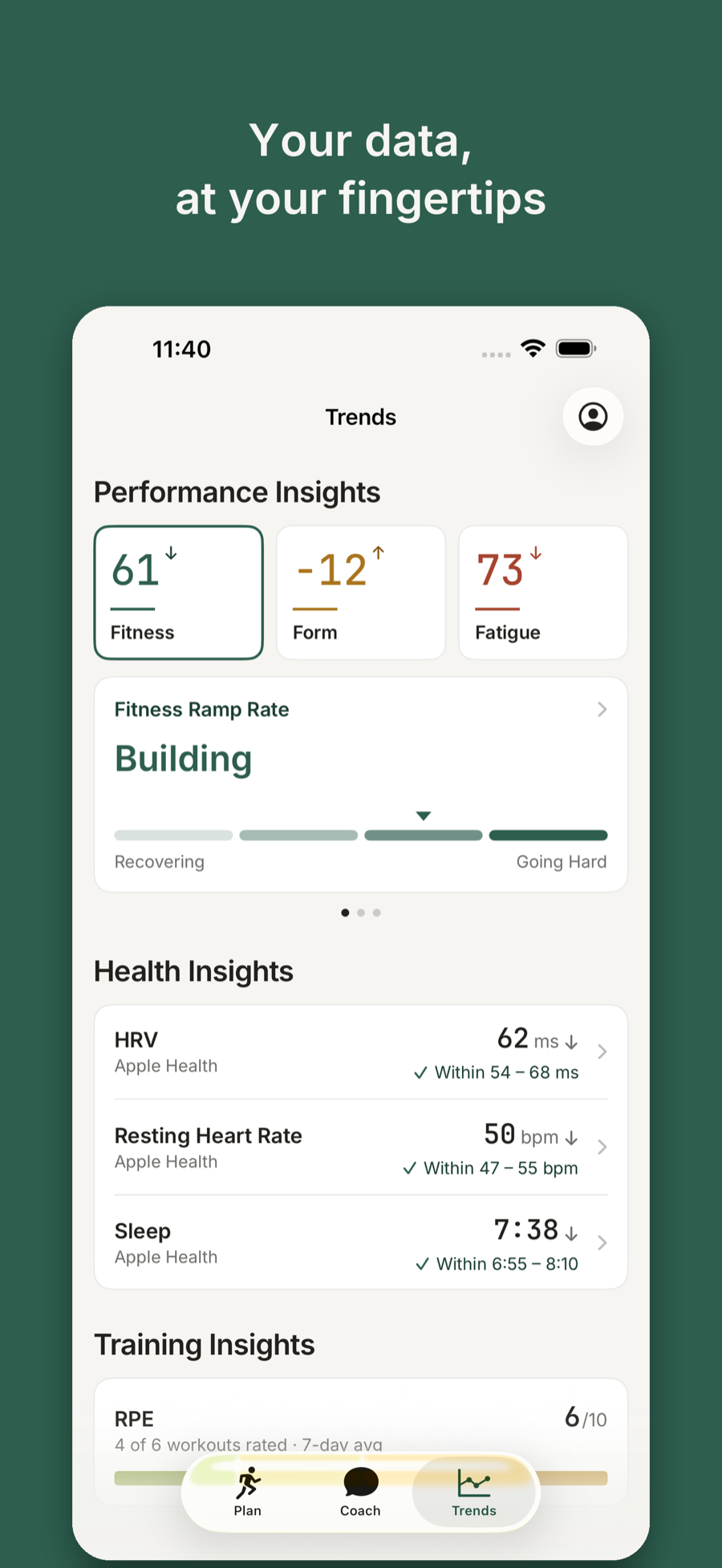
We just released Runsense 1.5. In it, you'll find a new tab: Trends. It shows the training and recovery metrics your coach reasons from:
- Performance: your fitness, form, and fatigue over time, so you can watch your build take shape.
- Health: HRV, resting heart rate, and sleep, each plotted against your own normal range.
- Training: your recent effort at a glance.
Race day approaches: Two Runsense athletes will be running the Never Summer 100k this Saturday, and I'm one of them! This'll be the longest distance I've ever done, so wish me luck!
Coach's Corner: a terrible, no-energy race isn't always about pacing.
A race that falls apart in a way your training didn't predict (flat legs, no energy, maybe walking for the first time) is usually put down to pacing or to what you ate that day. If it comes with two other things, losing weight without trying and an easy-run heart rate that has crept up even though your fitness should be improving, I read all three as symptoms of the same problem: your eating hasn't kept pace with your training load.
Any one of those alone doesn't mean much. One bad race happens. Some runners lean out as mileage builds. Heart rate creeps for plenty of reasons. Together, a flat no-energy race, weight you didn't mean to lose and an easy-day heart rate that has crept up usually point to one cause, not three.
Sports medicine calls that low energy availability: too little energy intake for the energy spent in exercise. A 2025 systematic review and meta-analysis of 59 studies found it in 2,737 of 6,118 athletes (44.7%) across 46 studies. Athletes with it had worse run performance, training response and endurance performance than athletes with normal energy availability. Most studies found impaired bone health and a higher risk of bone stress injuries, while results on injury in general were mixed. The review does not say how many of the athletes were runners (Gallant et al., 2025, Sports Medicine). The 2023 IOC consensus statement on Relative Energy Deficiency in Sport (REDs) describes outcomes that depend on whether the exposure to low energy availability is problematic or adaptable, alongside individual moderating factors, and introduces a clinical tool for detecting and diagnosing it (Mountjoy et al., 2023, British Journal of Sports Medicine).
The fix is usually more food, especially carbs, especially on hard days. If you are losing weight without trying and your races are getting worse, or you notice missed periods, frequent injuries or persistent fatigue, talk to your doctor or a dietitian rather than guessing.
If you want to see how your eating lines up with your training, the daily nutrition guide sets out what studies found.
This started as a post over on r/runsense, our little corner of Reddit. Come hang out: When a Bad Run Isn't Pacing or Fueling: Low Energy.
One running guide a week.
Calm, useful, no spam. Plain-English coaching from the Runsense team, once a week.