Is it bad to run in the cold?
The first properly cold morning of the year is when a lot of runners stop. The run that felt easy in October now starts with numb fingers and a burn in the chest, and it is easy to decide the cold is bad for you and wait for spring.
For most runs, it isn't. Cold changes a few things, and a coach plans around those few things rather than around the cold itself.
What the cold does not change
Your fitness works the same in the cold. Nine female endurance athletes ran on a treadmill in a climate chamber at temperatures from 20 down to -14 degrees C (68 to 7 F), with a 5 meter-per-second wind blowing at them. Their time to exhaustion, running economy, speed at lactate threshold and VO2max did not differ between temperatures (Renberg et al., 2014). It was a small group in a lab, on a dry belt, and it fits what coaches see: a runner who dresses for the day runs about as well as they did in the fall.
So a slow run on a cold morning is usually about the ground, the clothes or the first ten minutes, not about lost fitness.
What it does change
Your footing. Snow, slush and black ice make every stride cost more and make you careful, which is exactly right. On those days run by effort, at a pace you could talk at, and ignore the watch. A slow mile on packed snow is not a bad mile.
Your hardest efforts on the coldest days. Breathing hard in very cold, dry air is harder on the airways than breathing easily in it. Fourteen trained male runners did an all-out treadmill test at 18 and at -20 degrees C. In the cold they moved less air at their peak, and their lung function after the test was lower (Callovini et al., 2025). Exercise-induced asthma is common among elite cross-country skiers and biathletes, and a review puts it down to years of heavy breathing in cold air in training and racing (Carlsen, 2012). Neither describes an easy run on a 25-degree morning. They are the reason a coach moves an interval session on a frigid day indoors, or to the warmest hour, and keeps the easy runs outside. If your chest stays tight, or you cough for hours after running in the cold, see a doctor; it is treatable.
What you wear. Dress so you are a little cold for the first five minutes, cover your hands and ears, and wear layers you can take off and carry. Wind and wet are what make a run miserable, so a light shell matters more than a thick top.
How a coach plans a cold week
Jason Koop and Stephanie Howe, coaches at CTS, talked about winter training on KoopCast episode 209. Koop has athletes run routes where a normal loop takes one and a half or two times as long, so they stop caring about pace. For an athlete who struggles in bad weather, he puts a long session on the worst day of the forecast on purpose. Howe's view of the treadmill: a warm indoor day is fine, just not six days a week. Both coach ultrarunners, and the idea carries to any distance: you get better at the cold by running in it.
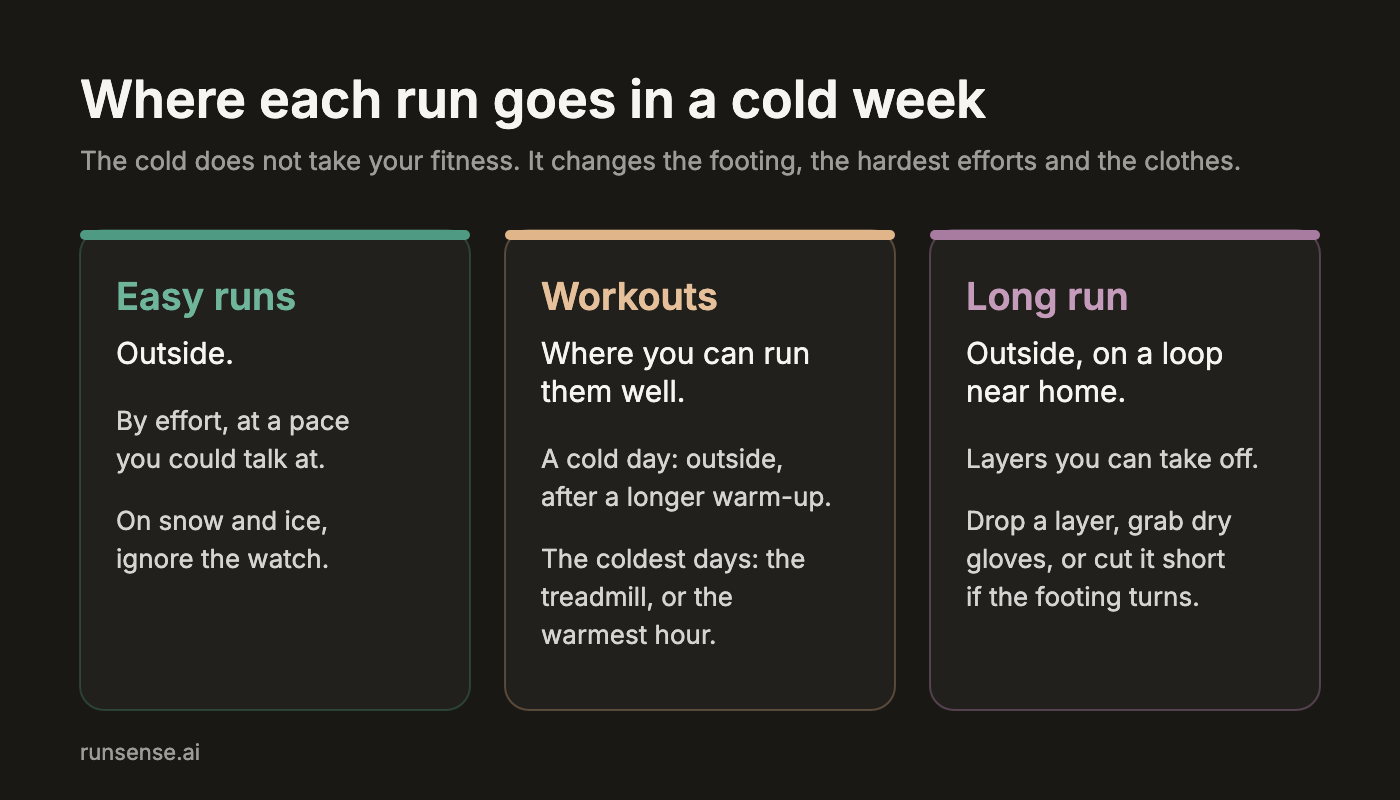
Put together, a cold week looks like this:
- Easy runs go outside. They are the runs the cold costs least, and they are how you get used to it.
- Workouts go where you can run them well. On a normal cold day that is outside after a longer warm-up. On the coldest days it is the treadmill, a track in daylight, or the warmest hour of the day.
- The long run stays outside, on a loop near home, so you can drop a layer, grab dry gloves or cut it short if the footing turns.
If your evenings are dark as well as cold, we wrote about setting your rule before the evening, and the guide to terrain and conditions covers wind, ice and running by effort.
What your coach does with this
Tell Runsense it is going to be 5 degrees on Thursday and you have a treadmill at the gym. It moves Thursday's intervals to the treadmill or swaps them with an easy day, keeps the long run on the weekend, and tells you what moved and why. If you are building toward a spring race, the plan still works back from that race date, so a cold week is part of the build and not a pause in it. If you haven't tried it, start your free 14-day trial.
Expert running advice, in your inbox.
Plain-English coaching from the Runsense team. No spam.