Why your watch's zone 2 feels too slow
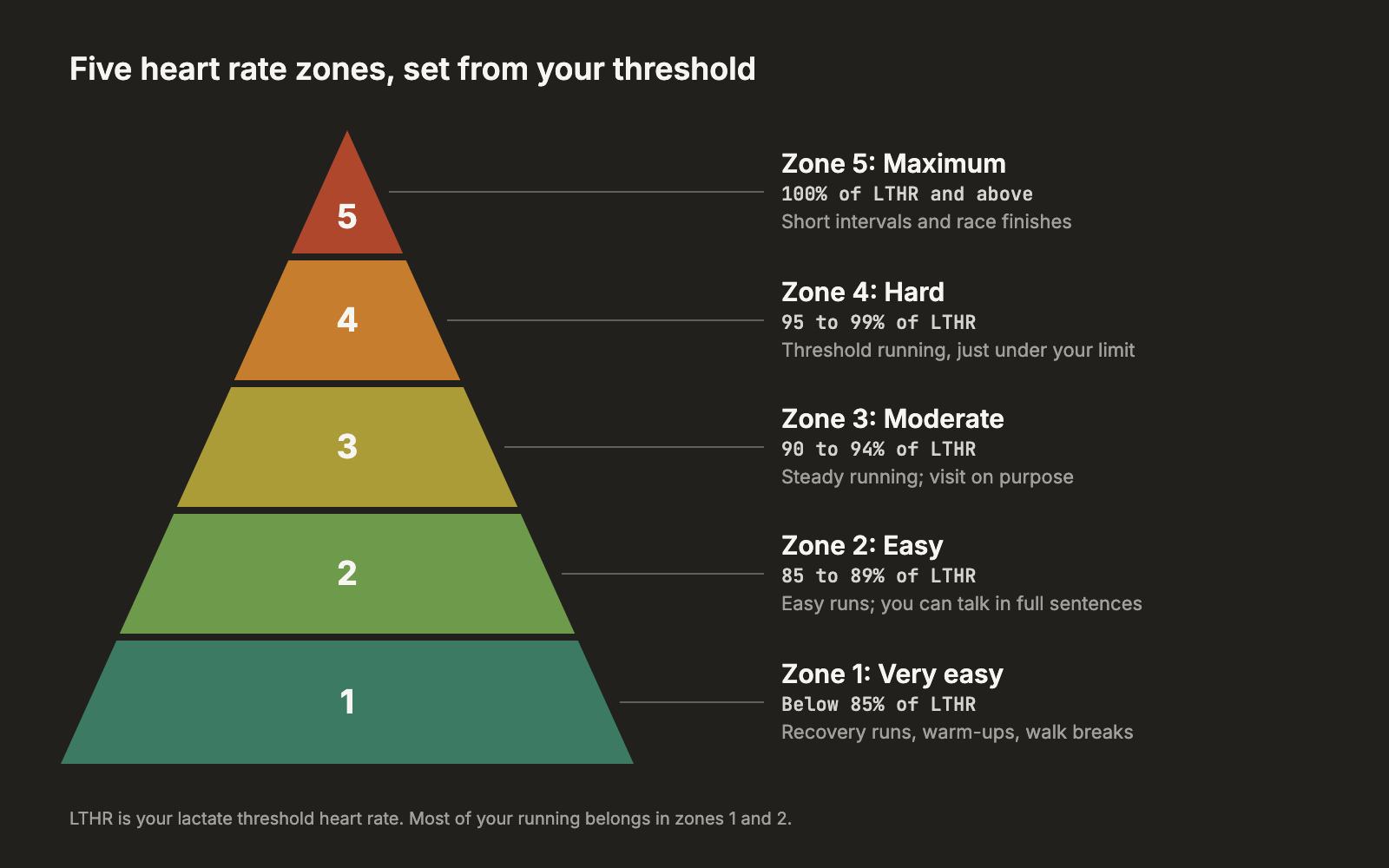
You went out to run zone 2 because everyone says that is where fitness is built. Your watch kept buzzing. To stay under its line you slowed to a shuffle, then to a walk on every hill, and you came home wondering how anyone gets faster like this.
One of our runners asked us exactly this in August. Their Garmin put zone 2 at 120 to 140 beats a minute. Their Runsense zones put it at 149 to 157. Same heart, same runner, a gap of more than 15 beats.
Your watch's zone 2 is probably too low
Your watch will give you heart rate zones on your first day, before it has seen you run. Garmin's manuals say the watch sets your default zones from the profile you entered at setup, and that zone 2 is 60 to 70 percent of your maximum heart rate.
That top line, 70 percent, is lower than where easy running actually ends for most runners. There is a point where your breathing deepens and an easy run starts turning into work. Physiologists call it the first lactate threshold. When researchers tested 165 recreational runners on a treadmill, it came at about 80 percent of maximum heart rate on average, and a little higher in women than in men.
Here is what that means in beats. Say your maximum is 190. Your watch tells you zone 2 ends at 133. For a typical recreational runner, easy running goes on to about 152. That is a gap of almost 20 beats.
The watch's estimate of your maximum adds its own error. The age formulas miss a typical person's maximum by 11 to 12 beats, high for some people and low for others (our guide to heart rate zones has the studies). So for some runners the line ends up even lower. The age rule many runners use instead, 180 minus your age, has the same problem. David and Megan Roche say on Some Work, All Play (episode 334) that it is far off for perhaps 30 to 50 percent of runners, who end up jogging too slowly or running too hard.
What a zone set too low costs you
The slow miles themselves are not wasted. On Some Work, All Play (episode 321), the Roches' view is that three miles at a 14-minute pace and three at a 10-minute pace are the same thing aerobically. The cost is everything around them:
- Running stops feeling like running. You walk every hill, you shuffle on the flat, and the run turns into a chore. Runs that feel like chores are the ones that get skipped.
- You worry about one beat. The Roches say a strict heart-rate cap turns into anxiety over a single beat, so you spend the run staring at your wrist instead of running.
- You get slower. A block of nothing but capped, easy running leaves out the strides and faster running that keep you quick, and the Roches say that makes runners slow.
What a zone set too high costs you
Running easy days too hard does more damage. Coach Chris McClung says on Running Rogue (episode 421) that in recreational runners, overtraining usually starts with easy days run too fast. The signs are two to four bad workouts or weeks in a row, or feeling run down outside your runs while you can still hammer one. Coach Jason Fitzgerald says on the Strength Running Podcast that the first thing he checks in a runner who keeps getting hurt is whether their easy pace is too quick. ## If you are new to running
On the same Strength Running episode, Fitzgerald says a newer runner can hardly run in the lowest zone at all: within a minute they are in zone 3 or 4, because the aerobic system that makes easy running feel easy is not built yet. He does not fight that. He keeps their runs easy by feel, lets them land in zone 2 or 3, and adds easy time on a bike, in a pool or on an elliptical, where it is easy to stay low and the legs take no pounding. McClung uses walk breaks for the same job: one of his athletes, starting over after surgery, began with 2 minutes of running and 8 of walking and shifts the mix as her fitness grows.
Their reasons go beyond your heart. Easy running still builds your aerobic system, and the bike or elliptical lets you build it without running too hard. But Fitzgerald also keeps easy runs easy to keep the pounding on your legs low, so you are fresh for the next run. That matters most when you are new. Your heart and lungs catch up to running faster than your tendons and bones do, and new runners get hurt more than twice as often per hour of running as experienced ones. And easy feels better: once you push past the point where your breathing deepens, most people start to enjoy the run less, and the runs you enjoy are the ones you keep doing.
How to find your own zone 2
- Wait on the test if you cannot yet run 45 minutes without stopping. Keep building your aerobic fitness first: run easy, using the talk test to keep it easy, and add strides to make your running more efficient.
- Run one honest test. Warm up for 10 to 15 minutes, then run 30 minutes on your own, as hard as you can hold evenly from start to finish. Your average heart rate over the last 20 minutes is your threshold heart rate, and your zones are set from it. Our guide to testing your lactate threshold heart rate walks through it.
- Wear a chest strap or an arm strap if you have one. Arm-worn monitors are now common and accurate: in a 2025 study comparing them with a chest strap, an arm-worn Polar sensor read within about 1.5 beats a minute on average, while a wrist-worn watch varied more from activity to activity. If all you have is the watch, run the test anyway. A wrist reading is far better than an age formula.
- Set your watch from that number. Most watches let you base your zones on threshold heart rate instead of maximum.
- Check it against your breathing. In zone 2 you can still talk in full sentences. The talk test guide covers it.
- Run by effort, not by pace. Heat, hills and a hard week all make the same easy effort come out at a slower pace. On those days, let the pace drop and keep the effort easy.
- Test again every couple of months. Fitzgerald says zones shift within a couple of months as your training changes.
What Runsense does with your heart rate
Runsense's coach can provide you with a guided lactate threshold test, then analyze the data and set your zones from it. It reads the heart rate from every run you do, so when it tells you a run was easy, or that one crept too hard, it is reading your zones, not a default from your watch's setup.
If you haven't tried it, start your free 14-day trial.
One running guide a week.
Calm, useful, no spam. Plain-English coaching from the Runsense team, once a week.